Showing posts with label Diamonds. Show all posts

Wednesday, 17 July 2013

A DIAMOND FOR THE LORD

I had a dream that I would be a diamond for the Lord,
a soldier in His army,
a bearer of His sword.
But I was born a piece of coal ‘fore Jesus came along,
not worth a lot and dirty too,
so many things were wrong.
Then trials and tribulation came that put me on my knees;
there seemed to be no end of pain
and I cried out, “Lord, please
Come heal my broken spirit, and make me what You will,
but do not let me suffer,
Lord, or make me climb that hill!”
But how the pressure grew and grew ‘till I was sure I’d break
into a lot of pieces and
worth nothing for His sake.
I near forgot the promise that out Lord would never leave,
and just as I was going to quit,
He sent faith to believe.
It took a while to see a little sparkle in that coal,
but soon the sparkle grew and grew
until He filled my soul.
And then by grace it came from coal, a diamond for the Lord,
a soldier in His army,
a bearer of His sword.
Ralph E. Johnson
March 10, 1994

Monday, 14 May 2012

The 9 Most Surprising Things Worth More Than Their Weight In Gold

By Meredith Margrave


Hold on to that... it's worth its weight in gold. 

But is it really? Although it's a common figure of speech, very few things actually meet the criteria.

Let's do the math:

Today, one troy ounce of gold is worth about $1,250. With the help of some basic multiplication and division, and our knowledge of weight conversions, let's derive some other basic gold prices, rounded up to the nearest dollar:

One troy ounce of gold = $1,250
One standard ounce of gold (slice of bread) = $1,140
One pound of gold (loaf of bread) = $18,229
One gram of gold (dollar bill) = $40
One kilogram of gold (pineapple) = $40,187
One ton of gold (small car) = $36,457,500

Friday, 13 April 2012

Reasons To Avoid Facebook

Reasons To Avoid Facebook


It's hard to imagine an initial public offering (IPO) as heralded as Facebook's. Even Microsoft's 1986 debut (at $21) didn't garner this much attention. It's rare when a product or service that's so ubiquitous and so central to people's day-to-day lives, becomes available for the public to purchase a position in. Imagine if our Cro-Magnon ancestors had found a way to securitize fire or the wheel.

How Much?

Liberal estimates set Facebook's upcoming book value in the exospheric 12-digit range. One fun side effect to a well-publicized IPO is that it gives prognosticators who have no skin in the game of chance to make unrealistic estimates about the company's market value. $100 billion? Sure, why not? Sounds more memorable than $7 billion or $11.9 billion. Neither of which would make a memorable headline, be easily rattled off by journalists or make a good follow-up story a few months later, when Facebook's book value peaks without ever approaching $100 billion.

Prices are opinions, we know that, and they often have little correlation to value. No less an authority than Adam Smith himself pointed this out, observing that diamonds are expensive yet have little intrinsic value, while water is vital and essentially free. So what of Facebook, which is little more than a glorified contact list interspersed with baby pictures and Zynga games? 

Followers

There are 845 million people that spend time on Facebook, or at the very least, have accounts. So, does that mean each one is worth around $118, and if so, to whom? Or is this a case of unnecessarily dividing one number by another? Even if the average Facebook user posts every conceivable detail about their life, could an ambitious marketer or advertiser get $118 of added value out of that? These aren't rhetorical questions, these are questions a conscientious investor needs to ask before going long with an overpublicized company, whose business model is easily replicable; and if you don't think Facebook can be replicated, ask the good folks at MySpace or Friendster.

Facebook's revenue stream is based solely on advertising; facebook doesn't sell anything directly. It's a lucrative advertising vehicle, to be sure, with over $3 billion in advertising revenue last year.

By far the biggest American IPO in history was that of VISA in 2008. Not that longevity is a necessary condition for success in the marketplace, but VISA was a decades-old concern with millions of paying subscribers, both on the cardholder and merchant sides, before going public. VISA's IPO was valued at $17.9 billion and four years later the company's book value sits at about a healthy $78 billion.

The next largest IPO in history (among those companies that still exist in the same form, thus excluding AT&T Wireless and General Motors) was that of Kraft Foods in 2001 at $8.7 billion. Again, a company that produces a tangible asset and with significant barriers to entry. Facebook has announced that it hopes to raise approximately $10 billion when it first trades publicly, a bold statement that any investor should take under advisement.

Thursday, 15 March 2012

7 Ways To Pick The Perfect Engagement Ring Without Breaking The Bank


By Mandi Woodruff 

For most guys, the thought of buying a pair of pants is daunting enough, let alone picking out the ring that could make or break their engagement.
"It's an uncomfortable purchase for guys," says Josh Holland, spokesperson for online jeweler BlueNile.com. "They go to a jewelry store and they're overwhelmed and confused." 
It was BlueNile's founder's awkward experience shopping for a ring that inspired him to launch the company in the first place. 
"(The company) is based on product education," Holland says. "No one here works on commission. We empower customers with information." In today's economy, that often means helping consumers track down a ring that not only suits their mate but their budget as well. 
Here are seven smart ways to save on your engagement ring: 
Forget the 3-month rule. The old adage that men should budget three month's salary for the perfect engagement ring is basically a load of bull. "That's a myth. There are no real rules. Men should make a budget and try to stick to it," Holland says.
Don't skimp on the cut. There are Four C's in diamond-shopping: cut, color, clarity and carat. "A diamond's cut is the most critical because it determines a diamond's brilliance (sparkle)," Holland says. "We really counsel people on not worrying about size so much as cut. If you have a really sparkly and brilliant ring it'll appear bigger than a bigger, lower-cut quality diamond.
Think outside the 'big box'. More than $1 billion of the $9.64 billion spent on engagement and wedding rings in 2010 came from online purchases. That's because online retailers like BlueNile offer prices anywhere from 20 to 40 percent lower than bricks-and-mortar shops. "A traditional retailer would buy ring for $1,000 and sell it for $2,000. We'll buy that and sell it for $1,300," Holland says.
Don't be afraid to go down a half-carat. You can save hundreds of dollars but knowing how the pricing system works for carat. "Diamond prices jump disproportionately at the carat and half-carat marks," according to Holland, so you'll want to buy just shy of those levels. "For example, instead of a 1 carat diamond, look for a .95. You'll save a significant amount of money, and the slight size difference will never be noticed."
Trust your eyes. Ask for an 'eye-clean' diamond, rather than 'flawless'. Most so-called "flaws" occur naturally in diamonds and can't be viewed by the human eye–no one will see what it is you're paying so much for. " To achieve the best value consider a near-colorless (graded G-H) instead of a colorless diamond (graded D-F) or a VS2 (Very Slightly Included) clarity grade as opposed to a Flawless clarity grade," he advises. 
Check the return policy. So, the worst has happened and your fiancee girlfriend hates the ring–what if it's too late to return it? That's the case at many high-end jewelers, which either have 24-hour policies or none at all. The good news is many have loosened up a little on returns and offer 30-day policies, including BlueNile. 
Buy Certified. "All diamonds are not created equal," Holland says. Don't pull out your credit card until you've seen certification by at least one independent grading agency–such as the Gemological Institute of America or the American Gem Society. "If your diamond has been graded by the jeweler behind the counter, it's a bit like the fox guarding the hen house," he says." 
Now see 15 things you should NEVER waste your money on > 

Tuesday, 13 March 2012

Reclusive Heiress’ Jewels, Locked in Vault for Decades, Expected to Auction for Millions


By TIM NEWCOMB | @tdnewcomb | 

AP 
Mrs. Huguette Clark Gower, daughter of the late Senator William A. Clark of Montana, copper magnate, in Reno, Nevada on August 11, 1930.

A set of diamond-dripping jewels, valued together at over $11 million, will head to auction at Christie’s in New York on April 17.
Formerly owned by reclusive heiress Huguette Clark, who died last May at the age of 104, the history of the jewels could likely remain a mystery forever, quite like the woman who owned them.
Clark, whose estimated $400 million estate remains in legal limbo because of two completely contradicting wills signed within a month of each other in 2005, stashed a pink cushion-cut 9-carat diamond ring (this is the big-ticket auction item, worth up to $8 million), a rectangular-cut colorless diamond ring of about 19 carats (worth up to $3 million), an emerald and diamond bracelet and another gem-adorned bracelet inside a bank vault for 80 years. According to MSNBC, Christie’s believes her mother, Anna, passed down the diamonds to Huguette.
Clark was a daughter of U.S. Senator William A. Clark, who amassed fortunes mining copper and constructing railroads. He has also been credited with founding Las Vegas — hence Nevada’s Clark County. Huguette was born in Paris, grew up in Santa Barbara, Calif., and was married briefly while in her twenties. She was last seen in public after signing divorce papers in Reno, Nev., in the 1930s and was photographed wearing the diamond bracelet.
Having never had children and disappearing from the public before the age of 30, Clark still enjoyed the arts and lived in Manhattan since her mother’s death in 1963, with the last two decades of her life mainly spent in a hospital bed.
As historians search for clues into Clark’s life, they hope the jewels and the sale of her three Manhattan apartments (with a total listing price of about $55 million) will offer insight into Clark’s decision to hide out for so long.
http://newsfeed.time.com/2012/03/13/reclusive-heiress-jewels-locked-in-vault-for-decades-expected-to-auction-for-millions/


Monday, 27 February 2012

10 Best Movie Kisses

10 Best Movie Kisses

From Here To Eternity
Burt Lancaster and Deborah Kerr
Set against the backdrop of Hawaii in the days prior to Pearl Harbor, this multi-Oscar winning movie had an all star cast that included Cliff Robertson, Frank Sinatra, Donna Reed and Ernest Borgnine. But it's best remembered for the beach scene, when waves crash over a prone Burt Lancaster and Deborah Kerr as they engage is one of the most passionate and famous movie kisses of all time.

Wednesday, 22 February 2012

Huge rare pink diamond found in Australia

By Amy Coopes
Mining giant Rio Tinto said it has unearthed a "remarkable" 12.76 carat pink diamond in Australia, the largest of the rare and precious stones ever found in the resources-rich nation.
Named the Argyle Pink Jubilee, the huge rough stone was found at Rio's pink diamond operations in the Kimberley region of Western Australia and would take 10 days to cut and polish, the miner said on Wednesday.
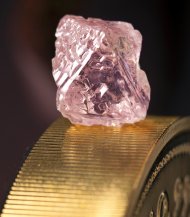
This photo, released by mining giant Rio Tinto on February 22, shows a 12.76 carat pink diamond -- the largest of the rare and precious stones ever found in Australia. Named the Argyle Pink Jubilee, the rough stone was found at Rio's pink diamond operations in the Kimberley region of western Australia and would take 10 days to cut and polish in Perth. (AFP Photo/)"This rare diamond is generating incredible excitement," said Josephine Johnson from Rio's Argyle Pink Diamonds division.
"A diamond of this calibre is unprecedented -- it has taken 26 years of Argyle production to unearth this stone and we may never see one like this again.
"The individual who gets to wear this remarkable pink diamond will be incredibly lucky indeed."
Though it would not speculate on how much the Jubilee was worth, Rio said extremely high quality pink diamonds could fetch in excess of US$1 million per carat, meaning it is likely to go for at least $10 million.
This photo, released by mining giant Rio Tinto on February 22, shows a 12.76 carat pink diamond -- the largest of the rare and precious stones ever found in Australia. Named the Argyle Pink Jubilee, the rough stone was found at Rio's pink diamond operations in the Kimberley region of western Australia and would take 10 days to cut and polish in PerthThe light pink Argyle Jubilee is a similar colour to the 24-carat Williamson Pink given to Britain's Queen Elizabeth II as a wedding gift which was later set into a Cartier brooch for her coronation.
The Williamson was discovered in Tanzania in 1947 and is ranked among the finest pink diamonds in existence. It is the ninth-largest in the world.
A Rio spokesman told AFP the recent discovery was named in honour of the long-reigning British monarch, who is celebrating 60 years since her accession to the throne -- her diamond jubilee.
"This is the Queen's diamond jubilee year and there is a parallel in that the Queen had a solitaire pink diamond, gifted to her -- The Williamson Pink -- and set in the centre of a flower brooch in the year of her coronation," he said.
When asked if Rio was targeting the Argyle Jubilee diamond at the Queen the spokesman said: "Only if she is shopping for new jewellery. She will have lots of competition."
Rio produces more than 90 percent of the world's pink diamonds from the Argyle mine, and said large stones like the Jubilee typically went to museums, were gifted to royalty or end up at prestigious auction houses like Christie's.
Christie's had only auctioned 18 polished pink diamonds larger than 10 carats in its 244-year history, Rio added.
Soaring demand for the extremely rare jewel has seen pink diamond prices skyrocket in the past 20 years and they are now among "the most concentrated forms of wealth on earth and well in excess of white diamonds," Rio said.
The miner describes it as an "elite and discrete" market with buyers including royalty, heads of state, celebrities and "other very wealthy individuals."
When the Jubilee diamond has been cut and polished it will be graded by international experts and showcased globally in private settings before being sold by invitation-only tender later this year.
It is not known how the diamonds acquire their pink tinge but it is thought to come from a molecular structure distortion as the jewel forms in the earth's crust or ascends to the surface.
According to local Aboriginal folklore, the Argyle mine was formed when a barramundi fish jumped through the net of three local hunters. The diamonds are its scales glinting in the sun and the pink ones are the fish's heart.


Thursday, 2 February 2012

Treasure hunter says he found $3B WWII wreck

By CLARKE CANFIELD | Associated Press

Greg Brooks, co-manager of Sub Sea Research, is seen aboard the salvage ship Sea Hunter in Boston Harbor Wednesday, Feb. 1, 2012 holding a picture of the British merchant ship Port Nicholson which was

Greg Brooks, co-manager of Sub Sea Research, is seen aboard the salvage ship Sea Hunter in Boston Harbor Wednesday, Feb. 1, 2012 holding a picture of the British merchant ship Port Nicholson which was sunk by a German U-boat in 1942 with a cargo of 71 tons of platinum now worth about $3 billion. Brooks will use the Sea Hunter to recover the cargo of the Port Nicholson. A port hole of the Port Nicholson can be seen on the screen behind Brooks. (AP Photo/Winslow Townson)


PORTLAND, Maine (AP) — A treasure hunter said he has located the wreck of a British merchant ship that was torpedoed by a German U-boat off Cape Cod during World War II while carrying what he claims was a load of platinum bars now worth more than $3 billion.