Showing posts with label Bees. Show all posts

Saturday, 22 September 2012

How bees decide

by David Catchpoole

Bee
When a hive gets too crowded, half the bees (together with the queen) swarm temporarily to a nearby tree to wait while several hundred go and scout for a new home. But how do they decide which site is best?
Photo Stockxpert
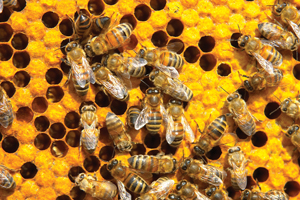
Bee hives
Photo by Amanda Greenslade
Bee
Researchers at Cornell University have now documented that the bees go through a group decision-making process, steadily narrowing down the options until a quorum develops.1,2 It’s long been known that honeybee scouts ‘waggle dance’ to report on food.3Researchers have now confirmed that they dance to report on real estate, too—the better the housing site, the stronger the waggle dance, and that prompts other scouts to visit the site.
If they agree it’s a good choice, they return to the swarm, and their waggle dance stirs other scouts to investigate the potential site, and so on. The researchers say that scouts advertising different sites compete to persuade uncommitted scouts to assess that proposed location. As bees grade their recruitment signals according to site quality, scouts build up most rapidly at the best site. Once a ‘quorum’ of scouts is in agreement, they signal to the waiting swarm that it’s time to move.
‘This is a striking example of decision making by an animal group that is complicated enough to rival the dealings of any department committee,’ said Cornell University’s Thomas Seeley. He and his colleagues found that when the range of potential sites was equal in quality, it took the swarm longer to decide than in situations where one site was clearly superior (e.g. in size).
One wonders how the bee ancestors survived while this system of communication and group decision making was evolving? Like the bee and its navigation system,4 it did not and could not have evolved, but reflects the design and purpose of the Creator.
References
  1. Lang, S., How 10,000 bees decide where to go when they fly the coop—decision-making to rival any department committee, Cornell University Chronicle Online, <www.news.cornell.edu/stories/April06/swarm.quorum.ssl.html>, 9 June 2006. Return to text.
  2. Seeley, T., Visscher, P., and Passino, K., Group decision making in honey bee swarms, American Scientist 94(3):220–229, 2006. Return to text.
  3. See Doolan, R., Dancing bees, Creation 17(4):46–48, 1995, <www.creation.com/beesdance>. Return to text.
  4. See Sarfati, J., Can it bee?, Creation 25(2):44–45, 2003, <www.creation.com/bee>. Return to text.

http://creation.com/how-bees-decide

Friday, 21 September 2012

Can it bee?

by Jonathan Sarfati
Honeybees fly with a remarkable agility that would be the envy of stunt pilots, yet their navigation ‘software’ is packed into a brain the size of a sesame seed. Now their techniques are being studied carefully at the All-Weather Bee-flight Facility at the Australian National University (ANU) in Canberra. There are plans to use them in miniature flying robotic spies and unmanned planetary exploration probes.1

How bees navigate

Bees have airspeed gauges; gyroscopes; a ‘compass’ that detects the polarization of sunlight; UV sensors to track the horizon to measure tilt; and two compound eyes, each with 7,000 hexagonal (six-sided) facets. These facets are windows to sub-eyes called ommatidia, which are tiny tubes containing their own lens and light-detecting cells. Each tube points in a different direction, enabling vision over a wide area. The hexagonal shape is ideal. It uses as little edge-cell material as possible (which is why the honeycomb is also hexagonal), has the least sharp corners needing less reinforcement, and is the most symmetrical structure. Such eyes are superb for detecting motion, since a small shift means different facets detect the image.

Bees outsmart supercomputers

by Carl Wieland
One of the most fiendishly complex mathematical computations is the so-called ‘Travelling Salesman Problem’. Given a list of locations (e.g. cities) and the distances between them, it involves finding the shortest possible route in which each location is visited only once. As the number of locations increases past anything more than a handful, the complexity of the problem increases dramatically, to staggering proportions.
‘In nature, bees have to link hundreds of flowers in a way that minimises travel distance, and then reliably find their way home—not a trivial feat if you have a brain the size of a pinhead! Indeed such travelling salesmen problems keep supercomputers busy for days.’—Professor Lars Chittka, University of London


Such computations “keep supercomputers busy for days”, says Professor Lars Chittka, from the University of London.1 Yet scientists from that university, using artificial computer-generated flowers, have found that bees learn to solve such problems, in effect, and extremely quickly.2 They are the first animals found capable of this—and they solve it for hundreds of locations.

Sunday, 25 March 2012

Make your landscaping butterfly-friendly

Attract beautiful and beneficial butterflies to your yard and garden!
by Networx.com
Butterfly in a garden 
There is something magical about butterflies as they flit from flower to flower in the garden. These winged beauties are not only stunning to watch but they also serve an important role as pollinators, spreading pollen from flower to flower,  leading  to fertilization and ultimately seed production. The activities of butterflies and other pollinators, like hummingbirds and bees, help to ensure that various plant species multiply and persist. 
 
By growing certain combinations of plants and providing the right setting, you can attract butterflies and other welcome pollinators to your garden. Here are some tips for attracting butterflies.
 
1.   Certain butterflies will only lay their eggs on specific plants. Find out what types of butterflies are in your area. This can be done through observation or by utilizing field guides.
 
2.   You will need to plant both host and nectar plants. Host plants provide larval food for caterpillars and a place for them to lay their eggs. Once the caterpillars become butterflies, nectar plants are an important food source. If you grow herbs for cooking, plant a few extra for the butterflies. 
 
3.   Situate your butterfly garden in a location that receives 4-6 hours of direct sun. 
 
4.   Provide a source of shallow water (puddles are great), warm flat rocks for butterflies to sun on and some protection from strong winds. Shrubs are a good way to provide the necessary shelter. 
 
5.   Avoid using chemical pesticides which  kill both bad and good bugs, including caterpillars. 
 
6.   Select a range of plants so that you will have blooms from spring until fall. This will maximize the opportunity to attract butterflies. 
 
Below is a partial list of both host and nectar plants to attract and feed butterflies. Be sure to check with your local native plant society to find out the best natives for attracting butterflies.
 
Herbs
Fennel – Both the green and bronze are hosts for Black Swallowtails.
Parsley – A host for Black Swallowtails.
Basil – Provides nectar.
Dill – Is both a host plant and a source of nectar.
 
Annuals
Cosmos – A nectar source for the Painted Lady.
Hollyhock – A nectar source for the American Painted Lady.
Pansies – A nectar source for the Yellow Sulfur.
Salvia species – A host plant for many different butterflies.
Sunflowers – A larval source for the Painted Lady.
Verbena species – A nectar source for the Checkered Skipper.
Zinnia species – A nectar source for the Western Tiger Swallowtail.
 
Perennials
Asclepias species – Butterfly weed is both a host plant and a source of nectar for Monarchs.
Aster species – A nectar source for Black Swallowtails.
Echinacea species and cultivars – Coneflower is a nectar source for the Common Wood Nymph.
Eupatorium purpureum – Joepye weed is a nectar source for Giant Swallowtails.
 
Shrubs and Trees
Asimina triloba – Pawpaw is a host for the Zebra Swallowtail.
Buddleia davidii – The butterfly bush is a nectar source for the Black Swallowtail and Monarchs.
Fraxinus pennsylvanica – The green ash is a larval source for two types of Swallowtails.
Lindera benzoin – The spicebush is a host for Spicebush Swallowtails.
Populus tremuloides – Quaking aspen is a host for Mourning Cloaks.
Prunus serotina – Black cherry is a host for the Tiger Swallowtail.
Salix species – Willow is a host for the Red Spotted Purple.
Prunus virginiana – Chokecherry is a host for the Western Tiger Swallowtail. 

Do bees and humans share a bold explorer gene?

Bee bold: “To Boldly Go Where No Bee Has Gone

Bee scouts—their mission: to explore strange new fields, to seek out new flowers and new sources of food, to boldly go where no bee from their hive has gone before.1 

But what motivates a bee scout? What makes her take risks, explore the unfamiliar, unselfishly bring back news of her discoveries and set out again to spend herself for the sake of the hive?

“Most foragers wait to be told what to do, but not scouts,” says entomologist Gene Robinson, whose team’s results were published March 9 in Science. “Scouts go out and search for food on their own.. . . Our results raise the interesting possibility that there’s a genetic toolkit for this kind of behavior.” Genetic activity associated with “novelty-seeking behavior”
2 has been identified in vertebrates,

Robinson’s team notes. They’d like to know if the same genes play an analogous role in bees.

Graduate student Zhengzheng Liang put a paint dot on bees visiting unfamiliar sugar water stations. “Food scouts, who make up 5 to 25% of a colony’s foraging force, search independently for new food sources,” the team found, “and continue to do so even when plentiful sources have been found.”
2 A smaller percentage of a swarm is devoted to nest site reconnaissance. Some bees do both, with nest scouts being 3.4 times more likely to join the food scout force than less adventuresome bees.2

To discover the biochemical underpinnings of such bold bee behavior, the explorers were dispatched and their little brains analyzed. Risk-takers demonstrated increased transcription from genes coding for the production of several kinds of neurotransmitter receptors. (Nerve cells pass on messages using various chemicals called neurotransmitters. Nerve cells that actively receive lots of messages may have lots of corresponding neurotransmitter receptors present on their cell membranes.) 


Increased activity of the same neurotransmitters has also been seen in some vertebrate animals and humans that are prone to try new and risky things. “These signaling systems also are implicated in personality differences between humans that are related to novelty seeking.”2 Follow-up tests in which the sugar water was laced with substances to enhance or inhibit these neurotransmitters also correlated with scouting behavior.

Robinson’s group concludes, “Our results demonstrate intriguing parallels between honey bees and human novelty-seeking behavior. Although the molecular mechanisms that produce this behavioral variation are similar, it is unknown whether both species inherited them from a common ancestor or evolved them independently.”
2

These results are what we would expect in a world whose biochemistry and inhabitants were designed by a common Designer. Of course, there is no way to know yet whether the increase in neurotransmitter activity is a genetic cause of behavior in scouting bees—or risk-taking people for that matter—or whether the increased activity results from the behavior.

A biblical understanding interprets this discovery as evidence that God used the same sorts of molecules in many different kinds of creatures. Genes for similar molecules are often similar, regardless of the organism, because the genetic “alphabet” is consistent throughout the living world God created.

Furthermore, God made all kinds of creatures about 6,000 years ago fully equipped with the behaviors needed to thrive. That certain behaviors are associated with particular biochemical manifestations does not suggest those behaviors evolved over millions of years.