
Showing posts with label Decision-Making. Show all posts

Saturday, 22 September 2012

How bees decide

by David Catchpoole

Bee
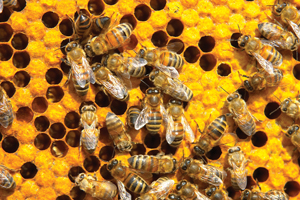
When a hive gets too crowded, half the bees (together with the queen) swarm temporarily to a nearby tree to wait while several hundred go and scout for a new home. But how do they decide which site is best?
Photo Stockxpert
Bee hives
Photo by Amanda Greenslade
Bee
Researchers at Cornell University have now documented that the bees go through a group decision-making process, steadily narrowing down the options until a quorum develops.1,2 It’s long been known that honeybee scouts ‘waggle dance’ to report on food.3Researchers have now confirmed that they dance to report on real estate, too—the better the housing site, the stronger the waggle dance, and that prompts other scouts to visit the site.
If they agree it’s a good choice, they return to the swarm, and their waggle dance stirs other scouts to investigate the potential site, and so on. The researchers say that scouts advertising different sites compete to persuade uncommitted scouts to assess that proposed location. As bees grade their recruitment signals according to site quality, scouts build up most rapidly at the best site. Once a ‘quorum’ of scouts is in agreement, they signal to the waiting swarm that it’s time to move.
‘This is a striking example of decision making by an animal group that is complicated enough to rival the dealings of any department committee,’ said Cornell University’s Thomas Seeley. He and his colleagues found that when the range of potential sites was equal in quality, it took the swarm longer to decide than in situations where one site was clearly superior (e.g. in size).
One wonders how the bee ancestors survived while this system of communication and group decision making was evolving? Like the bee and its navigation system,4 it did not and could not have evolved, but reflects the design and purpose of the Creator.
References
  1. Lang, S., How 10,000 bees decide where to go when they fly the coop—decision-making to rival any department committee, Cornell University Chronicle Online, <www.news.cornell.edu/stories/April06/swarm.quorum.ssl.html>, 9 June 2006. Return to text.
  2. Seeley, T., Visscher, P., and Passino, K., Group decision making in honey bee swarms, American Scientist 94(3):220–229, 2006. Return to text.
  3. See Doolan, R., Dancing bees, Creation 17(4):46–48, 1995, <www.creation.com/beesdance>. Return to text.
  4. See Sarfati, J., Can it bee?, Creation 25(2):44–45, 2003, <www.creation.com/bee>. Return to text.

http://creation.com/how-bees-decide

Tuesday, 22 May 2012

Jesus in the Every day


How does Jesus affect people’s lives today?
In the time Jesus walked the earth, followers of Jesus would tell people of their personal encounters with him. At the end of The Passion of the Christ, we see Jesus get up from the tomb as He comes back to life from the dead – he is living today. People are still telling stories of their encounters with Jesus some two thousand years later. 
Explore the impact and relevance Jesus has today through these snapshots of people’s lives.
1) Free to make decisions without fear
I’m a planning freak and am always looking for the next step. Recently I had to make a pretty big career decision. As I weighed the pros and cons of the choice, I decided to try praying. Maybe I could glean some supernatural insight into my situation that felt so foggy.

Tuesday, 17 April 2012

Choose Your Part

“Then the king said, ‘Bring me a sword.’ So they brought a sword for the king. He then gave an order: ‘Cut the living child in two and give half to one and half to the other.’ The woman whose son was alive was deeply moved out of love for her son and said to the king, ‘Please, my lord, give her the living baby! Don’t kill him!’ But the other said, ‘Neither I nor you shall have him. Cut him in two!’ ” — 1 Kings 3:24–26


In the opening chapters of the book of Kings, King Solomon is granted one wish. In this original genie-in-the-bottle moment, God appears to Solomon in a dream and invites him to ask for anything. King Solomon chooses to ask for wisdom. He places wealth, health, and immortality on the back burner, so that he can best serve God in his role as the king.

Immediately afterwards, we read the famous story about two women who approach the king about a dispute over a baby. The first woman claims that the other woman stole her baby after the woman accidentally killed her own child when she rolled over the baby during the night. The second woman denies the claim and insists that the living child is hers. King Solomon’s new gift of wisdom is demonstrated to the nation as he cleverly discerns the truth by offering to cut the baby in two in order to give both women half. As Solomon anticipates, the true mother is revealed when the second woman pleads with the king to give the whole child to the other woman rather than put the child to death.

Friday, 16 March 2012

What does depression feel like?


Image: Young Man Nude by the Seashore by Flandrian Hippolyte
Young Man Nude by the Seashore by Flandrian Hippolyte

“It was not really alarming at first, since the change was subtle, but I did notice that my surroundings took on a different tone at certain times: the shadows of nightfall seemed more somber, my mornings were less buoyant, walks in the woods became less zestful, and there was a moment during my working hours in the late afternoon when a kind of panic and anxiety overtook me…” – William Styron, Darkness Visible
Sometimes the Depression Self-Screening Tests are just too clinical, and the symptoms don’t really “click” with you. Some of the criteria are general, and if you’re suffering from depression, specifics are easier to understand. I know that I might not have diagnosed myself with depression just on the basis of those symptoms. I had no change in appetite, and no sleep problems (getting out of bed was what was difficult). Below are some un-clinical symptoms.
  • Things just seem “off” or “wrong.”
  • You don’t feel hopeful or happy about anything in your life.
  • You’re crying a lot for no apparent reason, either at nothing, or something that normally would be insignificant.
  • You feel like you’re moving (and thinking) in slow motion.
  • Getting up in the morning requires a lot of effort.
  • Carrying on a normal conversation is a struggle. You can’t seem to express yourself.
  • You’re having trouble making simple decisions.
  • Your friends and family really irritate you.
  • You’re not sure if you still love your spouse/significant other.
  • Smiling feels stiff and awkward. It’s like your smiling muscles are frozen.
  • It seems like there’s a glass wall between you and the rest of the world.
  • You’re forgetful, and it’s very difficult to concentrate on anything.
  • You’re anxious and worried a lot.
  • Everything seems hopeless.
  • You feel like you can’t do anything right.
  • You have recurring thoughts of death and/or suicidal impulses. Suicide seems like a welcome relief.
  • You have a feeling of impending doom – you think something bad is going to happen, although you may not be sure what, and/or…
  • …You have a very specific fear that torments you constantly.
  • In your perception of the world around you, it’s always cloudy. Even on sunny days, it seems cloudy and gray.
  • You feel as though you’re drowning or suffocating.
  • You’re agitated, jumpy and and anxious much of the time.
  • Your senses seem dulled; food tastes bland and uninteresting, music doesn’t seem to affect you, you don’t bother smelling flowers anymore.
  • Incessantly and uncontrollably into your mind comes the memory of every failure, every bad or uncomfortable experience, interview or date, like a torrent of negativity.
Note: I wrote this a few years ago, and it has made its way around the Net uncredited. If you want to reproduce it in any way, please look at the terms of the Creative Commons license at the bottom of the page.
Also see How Depression May Affect Your Life. Archived comments in response to this article can be found here.
Please feel free to post your comment about what depression feels like. Don’t post:
  • Questions about depression and how to handle it.
  • Comments on how you think it should be managed, including finding God.
  • Requests for other people to email you.
  • Your depression “biography”.
Please note that comments are moderated – if you post a comment, it will not show up until it is approved, and this can take a few days. Comments asking for responses will be edited accordingly.

Thursday, 1 March 2012

Lefties vs. Righties: How we decide differently


By Lylah M. Alphonse, Senior Editor, Yahoo! Shine | Healthy Living

We like to think that we make decisions based on our ideas of right and wrong -- and we do, to an extent. But according to recent research, our choices may also be influenced by something as simple as whether we're right or left handed.

That's because right-handed people are more drawn to things on the right side of a screen or page, while left-handed people look to the left. Cognitive scientist Daniel Casasanto of The New School for Social Research says it's part of the "body-specificity hypothesis" -- the idea thatour physical bodies affect the decisions we make and the way we communicate with one another. One of the easiest ways to measure this hypothesis is by looking at whether a person is a righty or a lefty.

"Handedness is a good tool (to use) because it's easily measurable, and our hands our important in how we interact with the physical world," Casasanto explained to MSNBC.

In his study, which was published in a recent edition Current Directions in Psychological Science, a journal of the Association for Psychological Science, Casasanto found that people tend to prefer the things that they see or experience on the same side as their dominant hand.

"People like things better when they are easier to perceive and interact with," he says. Right-handers interact with their environment more easily on the right than on the left, so they come to associate "good" with "right" and "bad" with "left," he explained.
"Since about 90 percent of the population is right-handed, people who want to attract customers, sell products, or get votes should consider that the right side of a page or a computer screen might be the 'right' place to be," he added.
We even tend to use our dominant side to differentiate positive ideas from negative ones. In 2004, presidential candidates John Kerry and George W. Bush -- both of whom are right-handed -- gestured more often with their right hands when expressing positive thoughts or ideas. In 2008, both Barack Obama and John McCain were left-handed, and both candidates used their left hands more often when expressing something positive.

The association with positivity extends to the choices everyday people make as well. When Casasanto asked study participants to decide between two products to buy, two job applicants to hire, or two alien creatures to trust, right-handed participants regularly chose the ones on the right side of the page, while south-paws chose the ones on the left.

That influence seems to extend beyond the physical world, influencing even abstract ideas like intelligence and honesty. Which means that it affects the way we understand one another as well, Casasanto says

"Most of the time, we feel like we understand each other because what a word means to me, is close enough to what it means to you," he says. "But it's never the same, and what a word means in your mind may depend on quirks of your body."

While the preference seems to hold true even for kids as young as 5 years old, it isn't absolute. People who are right-hand dominant but lose the use of that hand, even temporarily, start to associate "good" with "left" instead of "right."

"After a few minutes of fumbling with their right hand, righties start to think like lefties," Casasanto said in a statement. "If you change people's bodies, you change their minds."