Showing posts with label Seniors. Show all posts

Saturday, 24 November 2012

Antibiotics: How Much Is Too Much?

(Ivanhoe Newswire) – It’s very easy to go to the doctor and get a prescription of antibiotics when you’re sick. But should you be taking them so often? A new study of Medicare data from 2007 to 2009 suggests that there was a wide discrepancy in antibiotic prescribing for older patients based on geography and the season in which the prescriptions for the medication were written. 

The overuse of antibiotics is common and can lead to unnecessary spending on prescription medicine, as well as increase the risk for adverse effects and antimicrobial resistance.


Yuting Zhang, Ph.D., of the University of Pittsburgh, and colleagues used Medicare data (comprising about 1 million patients per year) to examine geographic variation in antibiotic use among older adults in 306 hospital referral regions, 50 states and the District of Columbia, and four national regions (South, West, Midwest and Northeast). They also studied quarterly change in antibiotic use across the four regions.

Thursday, 18 October 2012

Sex and Seniors: The 70-Year Itch

By Loren Stein, M.A. 
Horny old broads, dirty old men. These commonly used terms speak volumes about how society views older people who are interested in sex.
Experts say such derogatory labels reflect a deep level of discomfort in our youth-oriented culture with the idea that seniors are sexually active. Sex is identified with reproduction, youthful attractiveness, and power -- and most young and even middle-aged people do not want to confront the inevitability of growing old.

Finding Joy in Praying for my Grandchildren


Written by Lillian Penner

family_praygrandkidsWhat a joy it is to have that precious little grandchild come running into your arms with hugs and kisses. The six-year-old granddaughter calling to tell you she lost her first tooth or your seven-year-old grandson excited about making his first goal in his soccer game.

In addition to the senior discounts, grandchildren are one of the rewards of growing older. Mary H. Waldrip says it well, “Grandchildren are God’s way of compensating us for growing old.”

Tuesday, 16 October 2012

Sex and Aging

By Chris Woolston, M.S., and Paige Bierma, M.A.


Nothing is more irritating to author Connie Goldman than the stereotypes out there about older people and sex -- especially the one about seniors not having sex. "People see an older couple that has just gotten married or who are holding hands, and they say, 'Oh, how cute,' " says Goldman, a former public radio producer. "It's belittling."
At age 76, Goldman spends a great deal of her time trying to counter those stereotypes. "There is this idea that all old people are alike, but my experience in interviewing hundreds of seniors is that each relationship is unique and different," says Goldman, whose recent book, Late-Life Love: Romance and New Relationships in Later Years, features interviews with 22 couples about their relationships.

Sunday, 23 September 2012

Why do we assume that as we age, our desire for sex is going to fade?S

Dr. Ruth, Westheimer, PhD, Sex Therapist:
God forbid! Don't assume it. 
People after 50 should continue to have a wonderful sex life if they so desire, if they say they don't want it anymore, I say goodbye, but if they so desire, but they have to be sexually literate. 
A woman has to know that after menopause she needs a lubricant, not to engage in intercourse with a not well lubricated vagina, it's painful, she's going to say, who needs it. 

Wednesday, 9 May 2012

Am I too old for sex at 70?

I’m 70 and we’ve been married for 50 years. He tells me I should no longer want it because I’m old.

Coleen Nolan
By Coleen Nolan
Getty
Dear Coleen,
My husband isn’t interested in sex any more.
I’m 70 and we’ve been married for 50 years. He tells me I should no longer want it because I’m old.

No Regrets! Successful Aging Means Letting Go of ‘What Ifs?’

Regretting past mistakes may help young people make better decisions in the future. But for the elderly, emotional health may mean not dwelling on things you can't change.


Edith Piaf, the French idol who popularized the song “Non, je ne regrette rien” (No, I have no regrets), was far from an example of healthy aging, dying of liver cancer at 47. But new research published in Science shows that a philosophy of “no regrets” may be critical to emotional health in later life.
Researchers imaged the brains of 21 healthy young people, 20 people who had developed depression after age 55 (they were mainly in their 60s at the time of the study), and 20 healthy senior citizens. While the participants were being scanned, they played a video game in which they opened a series of boxes, moving sequentially from left to right. Eight boxes were presented in each trial and opening each revealed either “gold,” which had a certain money value, or a picture of a devil, which meant the loss of all the winnings from the prior boxes.
Participants could choose to stop and collect their winnings at any point. At the end, the position of the devil was revealed, providing players an opportunity to see whether they’d stopped at the right time and won the largest possible amount. This, of course, carried potential for regret — even though the game was primarily one of chance, not skill.

Tuesday, 8 May 2012

Climate Change Could Be Tough on Seniors' Health: Study

Wide temperature swings in summer could lead to 10,000 excess deaths in U.S. per year
By Mary Elizabeth Dallas
HealthDay news image

MONDAY, April 9 (HealthDay News) -- Even small swings in temperatures could put elderly people with chronic illnesses such as diabetes, heart failure and lung disease at greater risk of death throughout the coming summer, a new study indicates.

Researchers from the Harvard School of Public Health in Boston found temperature fluctuations related to climate change could claim thousands of lives every year.

Experts predict climate change could increase variations in summer temperatures, particularly in the mid-Atlantic states and in parts of France, Spain and Italy. In these more volatile regions, this could pose a serious public health risk, the study authors claimed.

Top Five Airborne Threats to Senior Health

Senior citizens have their share of concerns these days, but perhaps the single most important issue they face is health care. With the baby boomer generation reaching retirement age and sweeping changes being proposed for pensions, retirement funding, and health care services, now more than ever senior citizens need to educate themselves on the unique factors affecting their health. One such consideration is indoor air quality (IAQ). Although air quality sometimes takes a back seat to other potential health hazards, experts contend that seniors should be especially concerned about the air they breathe. This article will examine five of the biggest influences on indoor air quality for seniors.

The subjects discussed below are not ranked in order of importance. Some factors will affect seniors more than others depending on the specifics of each individual situation. In fact, smoking is commonly regarded as the number one air quality issue for seniors. The health effects of tobacco smoke are of course well documented. The five concerns below are air quality issues that may be less understood by seniors and the general public. Always contact your regular health care provider if you feel that you are experiencing symptoms from poor IAQ.

Thursday, 3 May 2012

Mental Health Myths


"KIDS WILL BE KIDS"

Myth: Teenagers don't suffer from "real" mental illnesses — they are just moody.


Fact: One in five teens has some type of mental health problem in a given year.


(National Institute of Mental Health/Harvard University Study June 2005)


Myth: Talk about suicide is an idle threat that need not be taken seriously.


Fact: Suicide is the third leading cause of death among high school students and the second leading cause of death in college students. Talk about suicide should always be taken seriously.


(Jed Foundation)


Myth: Childhood mental health problems are really the result of poor parenting.


Fact: If someone in your family has a mental illness, then you may have a greater chance of developing the illness, but mental illness generally has little or nothing to do with parenting.

One in four families is affected by a mental health problem(Surgeon General's Report on Mental Health)

Tuesday, 3 April 2012

Need Prayer?

Prayer Request image

SENIOR LIVING MINISTRIES WOULD LIKE TO PRAY FOR YOU.

If you have come to this page, more than likely you are a senior adult who needs prayer. Senior Living Ministries is prepared to help... and we want you to know that you are not alone.

We believe God answers prayer and our volunteers are available to pray for your request.

Your request will be lifted up in prayer by our team and all information is kept confidential.

Please fill out the information below and click Submit Prayer Request to send us your prayer request.

Need Encouragement?


Get Daily Living Devotionals from Senior Living
If you have come to this page, more than likely you are a senior who needs encouragement. Senior Living Ministries is prepared to help...and we want you to know that you are not alone.

We'd like to send you our free Daily Living Devotionals by email. Daily Living Devotionals will encourage you with messages that apply Biblical truth to the issues that face us as seniors.

These free devotionals are sent to you each weekday via your email. You can easily unsubscribe or resubscribe at any time.

Please fill out the information below and click Submit to recieve Daily Living Devotionals by email.
First Name *
Postal Address


PRIVACY STATEMENT: You will only receive information you request from Senior Living Ministries (i.e., weekly email devotional). Your email address and information will not be disclosed to any other organization for any reason without your expressed permission.

Sunday, 4 March 2012

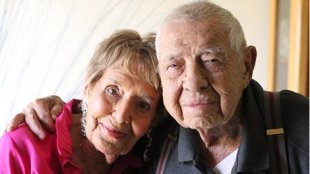
95-Year-Old Bride and 98-Year-Old Groom Become the World's Oldest Newlyweds


By Bridal Guide | Love + Sex

When Lillian Hartley, 95, and Allan Marks, 98, tied the knot this week, they unknowingly became the world's oldest newlyweds. Their combined 193 years broke the previous record of 191 years.
"Honest to God? Oh, I can't believe it," Hartley told The Desert Sun about breaking the record. "Oh, I'm impressed with myself."
Lillian Hartley, 95, and Allan Marks, 98.
The happy couple met 18 years ago at temple on Yom Kippur in Palm Springs. He complimented her dress, and their relationship grew from there.
"I believe in fate and destiny a little bit and I think that was meant to be," Hartley told ABC News. "I had been a widow for six years and I really loved my freedom. …I said, 'Oh, I don't want a relationship,'…and then he came along, and somehow hooked me."
The couple moved in together soon after they began dating. Over the years, they had discussed marriage but, because of their busy lifestyle-they love to travel, go to temple, and watch the Los Angeles Lakers-they didn't find the time until Leap Day (guess that extra day really does come in handy!).
"We don't know for sure what's going to happen, so I'm not taking any chances. I want to be with Allan for the rest of my life," Hartley said.
Marks agrees: "I want to be with Lillian for the rest of my life."
As for their honeymoon, they're in no rush. "We celebrate every day," Hartley told The Desert Sun. After a pause, she added, "I might go to Swiss Donut and have one of the nice donuts."
-Kristen O'Gorman Klein 

Monday, 20 February 2012

Alzheimers Support – Debilitating Disease


Alzheimer’s Support – What is Alzheimer’s Disease?
Alzheimer’s disease is a form of dementia, a brain disorder that seriously affects a person’s ability to perform daily activities, and is most common among older people. The area of the brain that controls thought, memory, and language is affected by this condition. Alzheimer’s disease is named after the German doctor Alois Alzheimer. In the year 1906, Dr. Alzheimer noticed changes in the brain tissue of a woman who had died of an unusual mental illness. He found abnormal clumps, which are now called amyloid plaques, and tangled bundles of fibers, which are now called neurofibrillary tangles. Today, these are the signs of what is called AD (Alzheimer’s Disease).

Along with these plaques and tangled fibers, scientists have also discovered other areas of the brain that are affected. There is a loss of nerve cells within in the brain vital to memory and other mental abilities. The levels of chemicals that carry complex messages back and forth between the nerve cells are lower than those in a person who does not have AD. Therefore, AD may disrupt normal thinking and memory by blocking these messages between nerve cells.

Alzheimer’s Support – What are the Symptoms and Stages?
Normal aging can play tricks on diagnosing Alzheimer’s symptoms. Many people look healthy, but they are having trouble making sense of the world around them. Some of the Alzheimer’s symptoms are memory loss and changes in speech; confusion about the location of familiar places; taking longer to finish routine, daily tasks; difficulty with simple math problems and related issues like handling money, paying bills, or balancing a checkbook; poor judgment that leads to bad decisions; mood and personality changes; and increased anxiety.

As time goes on, the damaging process occurring in the brain worsens and spreads to other areas that control language, reasoning, sensory processing, and thought. The Alzheimer’s disease stages become more pronounced and behavioral problems can start to occur. In the last stage, damage to the brain’s nerve cells is widespread. Many times, the patient dies of other illnesses, such as pneumonia.
Alzheimer’s Support – How to Give Alzheimer’s Care?
If the patient is not cared for by a facility, the family member or caregiver assures that the patient is receiving the needed support. A person suffering from this disease needs plenty of time to organize his thoughts and put them together in order to communicate with his caretaker. Therefore, the caretaker must be patient, and not interrupt while waiting for a response or statement.

Sufferers also need familiarity and repetition in their daily lives. Because of the illness, they become confused and disoriented, so their belongings should always he placed in an easy-to-remember place. Along with that, there should be a daily schedule for the patient to follow.

In the final stages of Alzheimer’s, caretakers should make sure the patient is exposed to music. Studies have shown that music plays a very important part in the quality of their life. Music accesses various parts of the brain, and the combination of language and music, as in song, offers a greater chance of activating neurological pathways that are still in tact. Patients are able to retain musical perception, and they are likely to remember all the words to a song, although they cannot put a coherent sentence together.

Music is also a way to remind or introduce your loved-one to Jesus Christ. Playing loved hymns or singing favorite Christian songs with your Alzheimer’s victim can serve three purposes: helping them to trigger brain activity, comforting them by enjoying with them things they can still remember, and reminding them of their safety and security in Jesus. “There is a time for everything, a season for every activity under heaven” (Ecclesiastes 3:1). “Trust in the LORD with all your heart; do not depend on your own understanding. Seek his will in all you do, and he will direct your paths” (Proverbs 3:5-6). Jesus’ promises might seem distant during times of suffering, but He assures us that He is always here with us, through everything (Matthew 28:20).
allaboutlifechallenges.org