Showing posts with label Barley Harvest. Show all posts

Sunday, 28 April 2013

Ruth Triumphed Over Great Adversity

by Barbie Breathitt

Adversity and death pursue sinners, but the righteous gain happiness and prosperity. Our emotions will either produce positive or negative motions in our circumstances. Life is about learning to love God and serving others. Ruth is a good example of humble service and overcoming great adversity. Ruth, the Moabitess, continually spoke words of hope, and she obtained the power of grace to change her life. Boaz, Ruth’s kinsman redeemer, was a man of great wealth. He decreed over his reapers, “May the Lord be with you!” (Ruth 2:4) He inquired “whose young woman is this?” (Ruth 2:5) because Ruth stood out in the field. God looks for outstanding women. Our best years are ahead because God is with us; positive changes will bring success! Adversity will only cause us to gain strength and momentum as we learn to press into God.

Doors of Opportunity
Fear hinders our potential by causing us to remain in our current negative situation. In contrast, Ruth concentrated on the abilities God gave her and the love she felt for Naomi. She walked through the door of opportunity determined to overcome adversity. Positive attitudes give us energy to move forward. By managing our thoughts and moving in the Spirit, we will find ways to create solutions. God has a plan to prosper us (Jeremiah 29:11). Be diligent in seeking God’s heart on every matter. Work hard and solve problems as they arise. Placing God’s will first in our lives will ensure our success (Matthew 6:33). Abiding in His presence develops intimacy which enables us to carry His atmosphere into the world. His presence makes our path straight. The thoughts we think and the words we speak determine our success or failure. Ruth determined to find favor to prosper, and she did. How do we prosper? When condemnation, fear, or negative opinions enter our mind, cast them down. Refrain from entertaining critical, jealous evaluations. Refuse to listen to the accusing lies of the enemy. There is no condemnation in Christ, only love, hope, and grace. Ruth clung to Naomi and overcame devastation. Orpah, “the one who is quick to flee,” kissed her opportunity for a godly life good-bye. When opportunity presented itself, Orpah chose familiar comforts. She ran back to her dead gods, forsaking salvation.
Saturday, 15 December 2012

Ruth: Romance and Redemption

Ruth meets Boaz: Ruth 2
In Israel, the barley harvest began in the spring. The community in Bethlehem observed God’s law concerning harvesting: “When you reap the harvest of your land, do not reap to the very edges of your field or gather the gleanings of your harvest…. Leave them for the poor and the alien” (Leviticus 19:9-10).
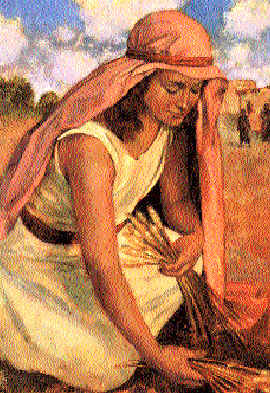
Ruth gleaning. By Dan Andreason
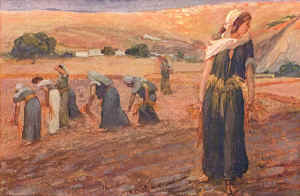
"And Ruth the Moabitess said to Naomi, ‘Let me go to the fields and pick up the leftover grain behind anyone in whose eyes I find favor’" (Ruth 2:2). Illustration above by Dan Andreason; below by James Tissot


Ruth and other gleaners.Ruth was both poor and an alien. She had few prospects in Judah, as Naomi had warned her. However, she was able to provide for Naomi and herself by working hard gleaning the grain left by the harvesters (Ruth 2:2).
There is an almost idyllic quality to the Bethlehem community described in Ruth, which — especially when one considers it existed during the turbulent period of the judges — testifies powerfully to the difference a few people living God’s way can make. Bethlehem would later become famous, first as the “town of David” and later as the birthplace of the Messiah (Luke 2:4-7).

“As it turned out, [Ruth] found herself working in a field belonging to Boaz, who was from the clan of Elimelech” (Ruth 2:3). Boaz was a “man of standing [Hebrew: ‘ish gibbor chail, implying Boaz was physically impressive and had noble character]” (verse 1).

Boaz asked his foreman who the stranger gleaning in the field was. The foreman replied that she was the young woman who had accompanied Naomi back from Moab. Boaz then told Ruth to continue gleaning in his field, and helped her far beyond the demands of the law. He even ordered his harvesters to make Ruth especially welcome, enabling her to gather extra barley.

Ruth then asked Boaz, “Why have I found such favor in your eyes that you notice me — a foreigner?” (verse 10). Ruth’s expression about finding favor in Boaz’s eyes, used by her on three occasions (verses 2, 10, 13), was a culturally appropriate way of showing respect. Ruth thus displayed the type of attitude the apostle Paul later taught Christians to have, when he said, “In humility consider others better than yourselves” (Philippians 2:3).