Showing posts with label Messiah. Show all posts

Friday, 19 April 2013

Why Did Jesus Need to Be Baptized?


Alfred Edersheim


Theories abound on the reason that Jesus submitted to baptism. After all, if He was sinless as the New Testament claims, then His baptism must have held some ulterior motive. Perhaps John and Jesus plotted or conspired together to gain attention for Jesus's ministry; perhaps Jesus came as a representative of the sinful human race; perhaps He submitted to baptism as foreshadowing His death and resurrection; or perhaps His baptism made the act of baptism work for everyone else.
Each of these theories, however, misses a few key elements. For example, we have no evidence that John or Jesus spoke prior to the time of the baptism, even though they were cousins. John lived in the wilderness and only knew what sign to look for. But most of all, John's baptism was not primarily a baptism of repentance (the turning away from sin). Instead, the submersion in water identified the person with the coming Messianic Kingdom.

Tuesday, 16 April 2013

Timing is Critical

Written by Bill Strom

“A man with leprosy came to him and begged him on his knees, “If you are willing, you can make me clean.” Filled with compassion, Jesus reached out his hand and touched the man. “I am willing,” he said. “Be clean!” Immediately the leprosy left him and he was cured. Jesus sent him away at once with a strong warning: “See that you don’t tell this to anyone. But go, show yourself to the priest and offer the sacrifices that Moses commanded for your cleansing, as a testimony to them.” Mark 1:40-44

This account of Jesus healing the leper early in his earthy ministry is peculiar. It runs against the grain that anyone new in town with an agenda to make a difference would tell people he helped to stay mum about it. Can you image politicians running for office cautioning people in their riding “Now be careful! Don’t tell others what I’ve done for you to make your life better!” It just doesn’t make sense.

Thursday, 11 April 2013

Who Touched Me? The Unclean Woman Healed by Jesus

Dr. Julie Barrier

Did you see the way I was walking? That’s the way I used to walk all the time. I used to be so weak. Not now. Not anymore. I’m Miriam. No, not THAT Miriam, Moses’ sister. She’s been dead about 1,000 years, I think. Anyway, I’m the one they used to call “unclean,” “dirty,” untouchable. You heard about me, didn’t you? Well, now you can call me Miriam the Healed Woman. I’m HEALED! You can touch me now. Go on, touch me!

This is my story: I married Simeon, and we were happy at first. I expected to have at least 3 children, but I never did conceive even one. I was so disappointed, and Simeon wasn’t happy about it at all. Men want sons. AND daughters. People here in Capernaum looked at me either with pity or suspicion, because we Jews believe that if a woman doesn’t conceive, she’s been cursed by God. I didn’t understand why God would curse me, so I kept hoping for a baby. It never happened. Then after one monthly cycle, the flow just kept on going. It wouldn’t stop.

Monday, 25 March 2013

The Annunciation

"In the sixth month, God sent the angel Gabriel to Nazareth, a town in Galilee, to a virgin pledged to be married to a man named Joseph, a descendant of David. The virgin's name was Mary." Luke 1:26-27

Today marks exactly nine months until Christmas. It was around this time the angel announced to Mary she would give birth to the Lord. Mary was at first afraid of this "birth announcement," but then she rejoiced at the thought of being the mother of the Messiah. She went straight to her cousin, Elizabeth, with the fantastic news.

Elizabeth had good news of her own. Although old and childless, she was also expecting. Mary and Elizabeth had plenty to hob-nob about. For three months these two moms-to-be delighted in their miracles. They probably did all the first-century versions of things expectant mothers do today: knitted baby clothes, collected blankets, diapers, bibs, toys, rattles, and pacifiers (a small piece of chamois, maybe?) I picture them as two birds on a perch, chattering and chirping about their impending families. Expectant mothers deserve this kind of luxury, right?

Sunday, 6 January 2013

Are You All In? - An Epiphany Devotion


Ever watch the "poker channel" on satellite TV? Perhaps you are a poker player yourself. In each game, perhaps after hours of ups and downs, a player will decide to bet everything. It's called going "all in." He pushes his whole stack of chips into the center of the table, knowing that he's either busted and out or will claim the whole pot. 

What is  Epiphany?
Video Devotion:
What is Epiphany?
The Magi who came to visit the newborn King, their King, were not just curious astronomers on a casual journey. They were from the Parthian (Persian) Empire, a bitter enemy of the Romans who had put King Herod on his throne and whose soldiers could be seen every day on Jerusalem's streets. For the Magi to travel hundreds of miles behind enemy lines was to risk their very lives. They were all in.

Sunday, 30 December 2012

Fulfilled Prophecies at the Birth of Christ

by Tim Chaffey, AiG–U.S

Another Reason to Rejoice this Season

Then the shepherds returned, glorifying God and praising God for all the things that they had heard and seen, as it was told them. (Luke 2:20)
Millions of Christians around the world choose to celebrate the birth of Jesus during this time of year—some on December 24 or 25 and others around January 7—while some choose not to celebrate at all. Whenever a Christian decides to celebrate, or if he elects not to celebrate His birth, we can all rejoice in the fact that, by putting on humanity, the Son of God became one of us to deal with our sin by dying in our place before conquering death when He rose from the dead.

History in Advance

Saturday, 15 December 2012

Ruth: Romance and Redemption

Ruth meets Boaz: Ruth 2
In Israel, the barley harvest began in the spring. The community in Bethlehem observed God’s law concerning harvesting: “When you reap the harvest of your land, do not reap to the very edges of your field or gather the gleanings of your harvest…. Leave them for the poor and the alien” (Leviticus 19:9-10).
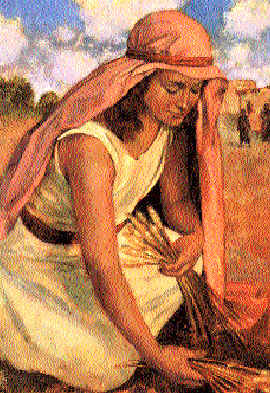
Ruth gleaning. By Dan Andreason
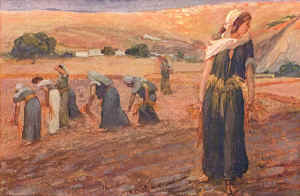
"And Ruth the Moabitess said to Naomi, ‘Let me go to the fields and pick up the leftover grain behind anyone in whose eyes I find favor’" (Ruth 2:2). Illustration above by Dan Andreason; below by James Tissot


Ruth and other gleaners.Ruth was both poor and an alien. She had few prospects in Judah, as Naomi had warned her. However, she was able to provide for Naomi and herself by working hard gleaning the grain left by the harvesters (Ruth 2:2).
There is an almost idyllic quality to the Bethlehem community described in Ruth, which — especially when one considers it existed during the turbulent period of the judges — testifies powerfully to the difference a few people living God’s way can make. Bethlehem would later become famous, first as the “town of David” and later as the birthplace of the Messiah (Luke 2:4-7).

“As it turned out, [Ruth] found herself working in a field belonging to Boaz, who was from the clan of Elimelech” (Ruth 2:3). Boaz was a “man of standing [Hebrew: ‘ish gibbor chail, implying Boaz was physically impressive and had noble character]” (verse 1).

Boaz asked his foreman who the stranger gleaning in the field was. The foreman replied that she was the young woman who had accompanied Naomi back from Moab. Boaz then told Ruth to continue gleaning in his field, and helped her far beyond the demands of the law. He even ordered his harvesters to make Ruth especially welcome, enabling her to gather extra barley.

Ruth then asked Boaz, “Why have I found such favor in your eyes that you notice me — a foreigner?” (verse 10). Ruth’s expression about finding favor in Boaz’s eyes, used by her on three occasions (verses 2, 10, 13), was a culturally appropriate way of showing respect. Ruth thus displayed the type of attitude the apostle Paul later taught Christians to have, when he said, “In humility consider others better than yourselves” (Philippians 2:3).

Saturday, 24 November 2012

The Servant, Steward of Justice


Isaiah 42:1–9

God’s word through Isaiah is that he has appointed a servant, or trusted envoy, who will usher in a new order—a bringer and establisher of justice, whom we all long for and look forward to with hope. Evangelical leader Charles Colson emphasizes how we need that hope:

We cry out for the demands of justice to be satisfied, and we even sense that they will someday … How could we possibly live with the unfairness of this world if we did not have a belief that at some point the accounts will be reckoned? The nonbeliever has to chalk this up to the spin of the wheel and futile human remedies. But the believer, who trusts in a loving God, knows all believers have the same ultimate hope.

Our longing for justice is fulfilled both now and in the “not yet” by Jesus the Messiah. Best-selling author Philip Yancey elaborates:

Saturday, 19 May 2012

The Forgiveness God Offers


Written by Dr. Bill Bright

This is part 1 of a 6 part series – The Forgiveness God Offers
Do you sometimes find it difficult to believe that you have total forgiveness for your sins in Jesus Christ? Intellectually you believe it, but how about deep within your heart?

Imagine yourself in the crowd as this story takes place as recorded in the Book of Luke:

Some men came carrying a paralyzed man on a sleeping mat. Seeing their faith, Jesus said to the man, “My friend, your sins are forgiven!”

“Who does this fellow think he is?” the Pharisees and teachers of the Law exclaimed among themselves. “This is blasphemy! Who but God can forgive sins?”

Friday, 20 April 2012

Beloved hymns carried King through troubled times

At 87, the Rev. C.T. Vivian can still recall the moment, decades after the height of the civil rights movement.

As he stood to conclude a meeting in his Atlanta home, the Rev. Martin Luther King Jr. joined his activist colleagues in song, his eyes closed, rocking back and forth on his heels.

“There is a balm in Gilead,” they sang, “to make the wounded whole.”

As the nation pauses Monday (Jan. 16) to mark King’s birthday, those who knew him say hymns, spirituals and other religious songs helped carry him through troubled times.

The spiritual fit King’s unique circumstances, said Vivian, who recently was named vice president of the SouthernChristian Leadership Conference, the civil rights organization co-founded by King.

“The average Christian doesn’t have to pick up his phone when it rings and think about somebody killing him or his children,” said Vivian. “The average Christian didn’t have any of that.”

Friday, 6 April 2012

The Temple: Not One Stone Will Be Left

Dr. Ray Pritchard
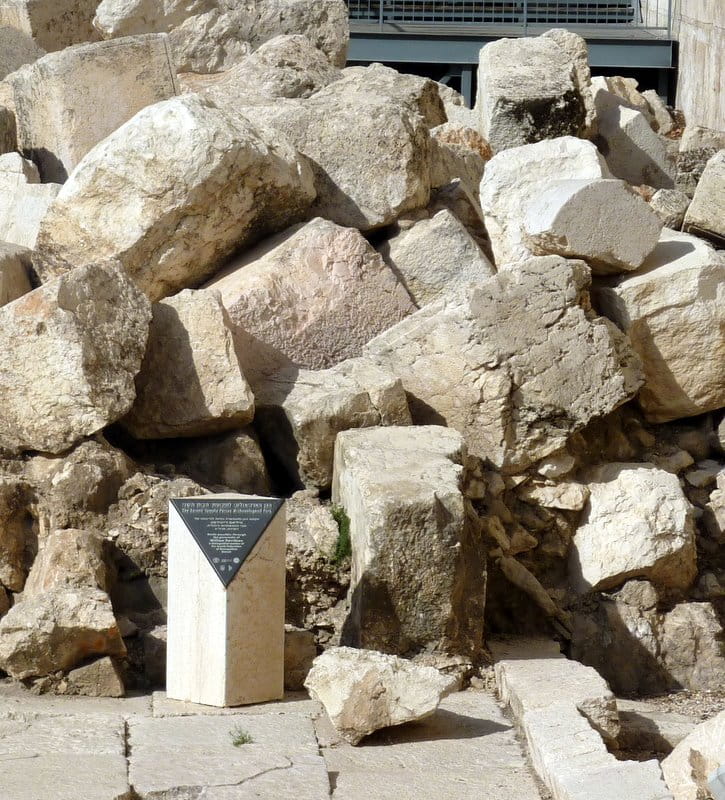
Stones from the destruction of the temple in 70 AD.

“They will not leave one stone on another, because you did not recognize the time of God’s coming to you”(Luke 19:44).
Jesus loved Jerusalem.
When he uttered these words, he was weeping. 
No doubt his hearers didn’t take him seriously when he said that the great temple in Jerusalem, Herod’s Temple, would someday be torn down. On that bright and warm day in early April, it must have seem quite impossible that anyone could or would destroy the temple. 
Who would do such a thing?
The answer would come in 70 AD when the Roman army captured Jerusalem and destroyed the temple. The Romans evidently took their work seriously because when they were done, there was no temple. It was gone, destroyed, burned down, all the way to the massive foundation stones.
One day it was there.
A few days later it was gone.
Just as Jesus had predicted.
It happened because Israel “did not recognize the time of God’s coming to you.” Another term for this is the “Day of Visitation,” a moment in history when God comes in blessing and power. When Jesus came, God was “visiting” his people. He showed himself in word and in deed to be mighty Son of God from heaven, the long-awaited Messiah. But his own people would not listen to him. 
They could have known.
They should have known.
There is a message for us for those with ears to hear.
If we do not respond to God’s call, we will one day face his judgment.
If we brush aside his blessings, we will answer for it eventually.
If we think we have forever to say yes to Jesus, we will one day be rudely surprised.
The jumbled pile of rocks sends a message to those who read these words.
Don’t let this happen to you.
Let us be warned, O Lord, so that we will not miss the day of God’s coming to us. Give us eager hearts to respond when you call. Amen.

You can reach the author at ray@keepbelieving.com. Click here to sign up for the free email sermon.

About Dr. Ray Pritchard

Dr. Ray Pritchard is the president of Keep Believing Ministries, in Internet-based ministry serving Christians in 225 countries. He is the author of 27 books, including Stealth Attack, Fire and Rain, Credo, The Healing Power of Forgiveness, An Anchor for the Soul and Why Did This Happen to Me? Ray and Marlene, his wife of 37 years, have three sons-Josh, Mark and Nick, two daughters-in-law--Leah and Vanessa, and two grandsons--Knox and Eli. His hobbies include biking, surfing the Internet, and anything related to the Civil War.


Did the Crucifixion Take God by Surprise?


Dr. Doug Bookman

The phrase "God has a plan" has become something of a cliché—with a negative connotation for many people. But in the circumstances leading up to the crucifixion of Jesus, the Gospel accounts provide confirmation that God does indeed have all things well in hand.
Far from being surprised or swept along, Jesus carefully orchestrated the events of the Passion Week (His last week on earth). This doesn't mean He manipulated those responsible for sending Him to the cross; rather, He brought out their seething hatred and true responses to His teaching.
According to Acts 2:23, the crucifixion progressed according God's prior intent, and the Passion Week allows us a glimpse at just how this happened. With His arrival during the Triumphal Entry, Jesus came as the promised Messiah at exactly the right moment in history (see Daniel 9). The common people welcomed Him with Messianic shouts of "Hossana," something completely intolerable to the Pharisees. However, the elite Sadducees enjoyed control of the Sanhedrin (the religious council), and even this type of welcome did not move them.
So, Jesus took His message to them. On Monday, He cleansed the Temple of moneychangers for the second time during His ministry and then staked His rightful claim to His Father's House. In fact, He wouldn't even permit merchandise to be carried through the Temple (Mark 11:16). The Sadduceesdid notice someone invading what they considered to be their turf.
Thanks to the superficial favor of the crowd, Jesus kept the leaders of Israel at bay for several days until the time appointed by God. And even then, those same leaders still feared the crowd's response enough to conduct a nighttime trial and to take Him to the Romans for death by crucifixion rather than by stoning, just as the Old Testament had shown.
The wickedness of humanity put Jesus on the cross, but none of the events took Him by surprise. He had warned His disciples when, where, and how His death would come because God had planned it before the earth had form.
Dr. Doug BookmanAdapted from the lecture notes of Dr. Doug Bookman, professor of New Testament Exposition at Shepherds Theological Seminary (used by permission).