Showing posts with label Bethlehem. Show all posts

Friday, 19 April 2013

Did Herod Kill the Children in Bethlehem?


Alfred Edersheim


Herod the Great, the misnamed king of Judea during the time of Christ's birth, received his title more for the force of his rule and expensive building projects than for his moral scruples. Only by the authority of Rome did he obtain a kingdom—and even then, many rebellions marked his reign. His insecurity aroused a murderous suspicion in him that touched even his own family.
Despite his reputation, however, some critics have wondered why no other historian—at least in the accounts available to us—mentions Herod's murder of the children of Bethlehem. In fact, the only account we have comes from Matthew 2:16, which has led to claims that the slaughter is a myth.
Sadly, that this event is only recorded by Matthew attests to the cruelty Herod became known for. Other than the murder of several members of the Jewish nobility when he first captured Jerusalem, his paranoia led to the execution of his uncle, his children (along with the executions of 300 adherents to their cause), and even his wife. And this is but a small sample of the devastation left by his tyranny. Any perceived threat to his crown, real or imagined, earned brutal punishment.

Sunday, 30 December 2012

Fulfilled Prophecies at the Birth of Christ

by Tim Chaffey, AiG–U.S

Another Reason to Rejoice this Season

Then the shepherds returned, glorifying God and praising God for all the things that they had heard and seen, as it was told them. (Luke 2:20)
Millions of Christians around the world choose to celebrate the birth of Jesus during this time of year—some on December 24 or 25 and others around January 7—while some choose not to celebrate at all. Whenever a Christian decides to celebrate, or if he elects not to celebrate His birth, we can all rejoice in the fact that, by putting on humanity, the Son of God became one of us to deal with our sin by dying in our place before conquering death when He rose from the dead.

History in Advance

Do You Fear the Birth of Jesus?

by Jeremy Ham, AiG–U.S

The historical account of Joseph and Mary traveling to Bethlehem in preparation for the birth of Jesus is no stranger to many of us. On Christmas, we celebrate Jesus Christ’s birthday, remembering why He had come (John 3:16–17). Although what God has done through the Lord Jesus Christ gives us the reason to be joyful always, do you also fear God in light of Christ’s birth? The birth of Jesus Christ should either make you afraid or make you admire and revere our awesome God.


Admiration for Christ’s Birth

Christians have no need to be afraid. In fact, on Halloween, we discussed the topic of the fear and the proper response to it. We have God on our side, so why should we be scared (see Psalm 118:6)? However, this does not negate the need for a fear of God. In this article, we are referring to two different definitions of fear in this context—to be scared of something or to have a reverent fear in awe of God. When we fear God, we submit to God as our Creator and Savior, and we will praise and glorify Him for who He is and what He has done for us.

Saturday, 15 December 2012

Ruth: Romance and Redemption

Ruth meets Boaz: Ruth 2
In Israel, the barley harvest began in the spring. The community in Bethlehem observed God’s law concerning harvesting: “When you reap the harvest of your land, do not reap to the very edges of your field or gather the gleanings of your harvest…. Leave them for the poor and the alien” (Leviticus 19:9-10).
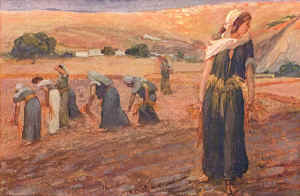
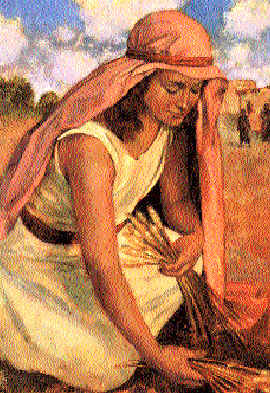
Ruth gleaning. By Dan Andreason
"And Ruth the Moabitess said to Naomi, ‘Let me go to the fields and pick up the leftover grain behind anyone in whose eyes I find favor’" (Ruth 2:2). Illustration above by Dan Andreason; below by James Tissot


Ruth and other gleaners.Ruth was both poor and an alien. She had few prospects in Judah, as Naomi had warned her. However, she was able to provide for Naomi and herself by working hard gleaning the grain left by the harvesters (Ruth 2:2).
There is an almost idyllic quality to the Bethlehem community described in Ruth, which — especially when one considers it existed during the turbulent period of the judges — testifies powerfully to the difference a few people living God’s way can make. Bethlehem would later become famous, first as the “town of David” and later as the birthplace of the Messiah (Luke 2:4-7).

“As it turned out, [Ruth] found herself working in a field belonging to Boaz, who was from the clan of Elimelech” (Ruth 2:3). Boaz was a “man of standing [Hebrew: ‘ish gibbor chail, implying Boaz was physically impressive and had noble character]” (verse 1).

Boaz asked his foreman who the stranger gleaning in the field was. The foreman replied that she was the young woman who had accompanied Naomi back from Moab. Boaz then told Ruth to continue gleaning in his field, and helped her far beyond the demands of the law. He even ordered his harvesters to make Ruth especially welcome, enabling her to gather extra barley.

Ruth then asked Boaz, “Why have I found such favor in your eyes that you notice me — a foreigner?” (verse 10). Ruth’s expression about finding favor in Boaz’s eyes, used by her on three occasions (verses 2, 10, 13), was a culturally appropriate way of showing respect. Ruth thus displayed the type of attitude the apostle Paul later taught Christians to have, when he said, “In humility consider others better than yourselves” (Philippians 2:3).

Thursday, 22 November 2012

Proof of Ancient Bethlehem Discovered in Jerusalem

Share on facebook

IFCJ

Imagine living in a place so rich with history that significant archeological finds are commonplace. That’s the reality in Israel.

Case in point: the recent discovery of a seal, or bulla, that dates from the 7th or 8th century BCE found in routine excavations by the Israel Antiquities Authority (IAA) in the walls around Jerusalem National Park.

Eli Shukron, director of the excavation for the IAA, explains the significance of the discovery, “This is the first time the name Bethlehem appears outside the Bible, in an inscription from the First Temple period, which proves that Bethlehem was indeed a city in the Kingdom of Judah, and possibly also in earlier periods.”
For archaeologists this is important because the small clay seal provides evidence of what Christians and Jews have long known to be true -- that Bethlehem wasn’t a “fabled biblical town,” but a real bustling city filled with commerce and trade with neighboring towns. 

Friday, 20 April 2012

Naomi: Having Hope Through the Famines of Life

And Naomi said, "I went out full, but the Lord has brought me home again empty." ~ Ruth 1:21 (AMP)
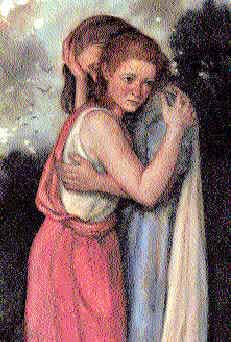
Naomi Bible Study-Ruth and Naomi Hugging
Have you ever gone through a famine in your life?

In this Bible study on Naomi, we will look at how God turned one woman's famine into a bountiful harvest. We will learn how, even in her darkest hour, God's plan was working to shine His light on Naomi's life.

Though she felt abandoned, He had in no way forsaken her. In all of her darkness, God had left Naomi a ray of hope.

This is the first of two Bible studies on the Book of Ruth. The next lesson with focus on Ruth herself. But, this Bible study on Naomi is here to give you hope in your life's driest seasons.

Tuesday, 10 April 2012

Bethlehem – the House of Bread

Scripture Passage  :  Genesis 35:15-20


INTRODUCTION : Genesis 35:19 is the first mention of Bethlehem in the Bible. The name means house of bread. This could mean a place where one could come and eat when hungry; a place of supply for the hungry (Isaiah 58:6-7). Historically, Bethlehem is just such a place. We will look at Bethlehem as a type of God’s supply for the hungry in five different incidents in the Bible. But first, let us visit the town of Bethlehem.

Bethlehem is located five miles south of Jerusalem (the distance from Antioch Baptist Church to downtown Knoxville). The mountains and valleys between the two cities make it impossible to see the one from the other. Bethlehem is located on a ridge one hundred feet higher than Jerusalem. It has a deep valley to its north and another to its south. This explains why the Philistines put a garrison there. 

To the east of Bethlehem, the land drops quickly down to the Dead Sea. To the west, there is a slightly milder drop to the Plain of Philistia. These slopes are known in ancient times for their terraced gardens. Bethlehem was normally a fairly small town. Biblically, it is the place of the death of Rachel, the birth of David and Jesus, and the marriage of Ruth and Boaz. We will see it as the house of bread.
  1. A PLACE OF WEEPING
    1. The Death of Rachel (Genesis 35:15-20)
    2. The Weeping of Rachel (Matthew 2:16-18)
    3. The Hope in Weeping (Jeremiah 31:15-17)
    4. Jesus: the Rest for the Weary (Matthew 11:28-30)
  2. A PLACE OF BLESSING
    1. The Loss of All (Ruth 1:1-5)
    2. The Return in Sorrow (Ruth 1:19-22)
    3. The Blessing for Ruth (Ruth 2:1-12)
    4. The Kinsman- Redeemer (Ruth 4:9-11)
    5. Jesus: Making Us the Sons of God (John 1:10-13)
  3. A PLACE OF ANOINTING
    1. The Choice of a King (1 Samuel 16:1-3)
    2. The Choice Not Expected (1 Samuel 16:6-13)
    3. The Promise of a Seed (2 Samuel 7:8-13)
    4. Jesus: the Son of David (Matthew 1:1; Luke 1:31-32)
    5. God’s Choice Today (1 Corinthians 1:26-29)
  4. A PLACE OF REFRESHMENT
    1. The Thirsty Soul (2 Samuel 23:14-15)
    2. The Three Mighty Men (2 Samuel 23:16); as the Trinity
    3. Jesus: the Source of Water (John 4:10-14)
  5. A PLACE OF SALVATION
    1. A Place of Taxation (Luke 2:1-7)
    2. The Birth of the Saviour (Luke 2:8-11)
    3. Jesus: the Saviour of the World (John 4:42; 1 Timothy 4:10)
CONCLUSION:
Are you weeping? Are you heavy?
Are you burdened down with sin?
Come to the town of Bethlehem
And let the Christ child in.
Are you thirsty? Are you hungry?
Seeking bread that satisfies?
Come to the town of Bethlehem
To Christ—the One who died.
Seeking purpose and direction;
Are you wandering in a maze?
Come to the town of Bethlehem
And let Christ show the way.
Have your dreams gone up in smoke?
Have you lost a loved one dear?
Come to the town of Bethlehem
Where Christ will make things clear.


by David F. Reagan
David Reagan

Ruth Goes to Bethlehem

Scripture Passage : Ruth 1:1-22


INTRODUCTION: The story of Ruth shows us God’s grace even in the time of the judges when every man did that which was right in his own eyes. This chapter sets the scene for the glorious blessings God will bestow on Naomi and Ruth. A simple outline of the book would be as follows: Chapter 1 – Ruth Remaining; Chapter 2 – Ruth Reaping; Chapter 3 – Ruth Resting; Chapter 4 – Ruth Rewarded.
  1. TRAGEDY IN MOAB (Ruth 1:1-5)
    1. The Time (Ruth 1:1)
      1. When the judges ruled
        1. The Book of Judges ends on a negative note with every man doing that which is right in his own eyes (Judges 21:25). The last few chapters in the book add to the somber mood of defeat and decline.
        2. But with the book of Ruth, God shows that He is still working to bring about His will. Even in the darkness of the time and the tragedies in the life of Naomi, God prepares the Messianic line for the birth of David.
      2. During a time of famine
        1. In the Bible, famines test men.
        2. They most often fail the test.
        3. Even Abraham went down to Egypt in the time of famine and lied to Pharaoh (Genesis 12:10-13).
        4. Interesting Point:  Bethlehem means house of bread . However, during the time of the judges, it became a place of famine.
    2. The Move (Ruth 1:1-2)
      1. From Bethlehem to Moab (Ruth 1:1)
        1. The city of Bethlehem-judah plays an important part during the time of the judges.
          1. It was the home of Ibzan, one of the judges (Judges 12:8).
          2. It was the original home of the Levite who eventually became priest of the false cult of Dan (Judges 17:7-9).
          3. It was the home of the concubine who was abused, killed, cut into pieces, and sent to the tribes of Israel (Judges 19:1-2).
        2. Now, it is the home of Elimelech and Naomi and will become the birthplace of David.
      2. Elimelech, his wife and two sons (Ruth 1:1-2)
      3. They continue in Moab (Ruth 1:2).
    3. The Tragedy (Ruth 1:3-5)
      1. Naomi’s husband dies (Ruth 1:3).
      2. Her sons marry Moabite women (Ruth 1:4).
        1. Note
          1. The Israelites were not to marry the people of the land (Exodus 34:11-16;Deuteronomy 7:1-4) – although the Moabites are not mentioned in these passages.
          2. The Moabites were not received into the congregation of Israel for ten generations (Deuteronomy 23:3-4).
            1. Because they would not allow Israel to pass through the land
            2. Because they hired Balaam to curse Israel
        2. Orpah and Ruth
        3. They continue about ten years.
      3. Her sons both die (Ruth 1:5).
  2. NAOMI RETURNS TO JUDAH (Ruth 1:6-7)
    1. She Determines to Leave Moab (Ruth 1:6).
      1. She hears that the famine is over.
      2. Her daughters-in-law arise to go with her.
    2. They Travel on the Way to Judah (Ruth 1:7).
  3. NAOMI SENDS HER DAUGHTERS-IN-LAW HOME (Ruth 1:8-13)
    1. She Gives Them Leave to Return Home (Ruth 1:8-10).
      1. She tells them to go to their mother’s house (Ruth 1:8).
      2. She blesses them for their kindness (Ruth 1:8).
      3. She desires that they might find husbands – notice the word rest  (Ruth 1:9; Ruth 3:1).
      4. She kisses them and they weep (Ruth 1:9).
      5. They both claim allegiance to her (Ruth 1:10).
    2. She Argues for Their Departure (Ruth 1:11-13).
      1. She has no sons for them to marry (Ruth 1:11).
      2. She is too old to have a husband (Ruth 1:12).
      3. Any sons would take too long to grow up (Ruth 1:13).
      4. The hand of the Lord is against her (Ruth 1:13).
  4. RUTH REFUSES TO LEAVE NAOMI (Ruth 1:14-18)
    1. They Weep Again (Ruth 1:14).
      1. Orpah leaves.
      2. Ruth cleaves.
    2. Naomi Encourages Ruth to Leave Also (Ruth 1:15).
    3. Ruth Declares Her Faithfulness to Naomi (Ruth 1:16-17).
      1. To go where she goes (Ruth 1:16)
      2. To lodge where she lodges (Ruth 1:16)
      3. To make her people her own (Ruth 1:16)
      4. To trust in her God (Ruth 1:16); it seems that Ruth has more faith in Naomi’s God than Naomi has (see Ezekiel 3:4-6).
      5. To die where she dies (Ruth 1:17)
    4. Naomi Accepts the Presence of Ruth (Ruth 1:18).
  5. NAOMI AND RUTH RETURN TO BETHLEHEM (Ruth 1:19-22)
    1. They Arrive in Bethlehem (Ruth 1:19).
      1. The city is moved.
      2. The people hardly believe it is Naomi.
    2. Naomi Expresses her Grief (Ruth 1:20-21).
      1. She wants to be called Mara [bitter – see Exodus 15:23] (Ruth 1:20).
        1. She is no longer Naomi [pleasant].
        2. God has dealt bitterly with her.
      2. She testifies of her sorrow (Ruth 1:21).
        1. She left full and returns empty.
        2. God Himself has testified against her.
    3. They Settle in Bethlehem (Ruth 1:22).
      1. Naomi and Ruth come from Moab.
      2. The time is the beginning of barley harvest. NOTE: This gives hope.  Naomi has suffered much and feels that the Lord Himself has turned against her. But the time of harvest is coming. Naomi will reap in joy.
CONCLUSION: When all goes wrong and we think God has turned against us, we are wrong. He may be just setting things up for a great time of blessing.